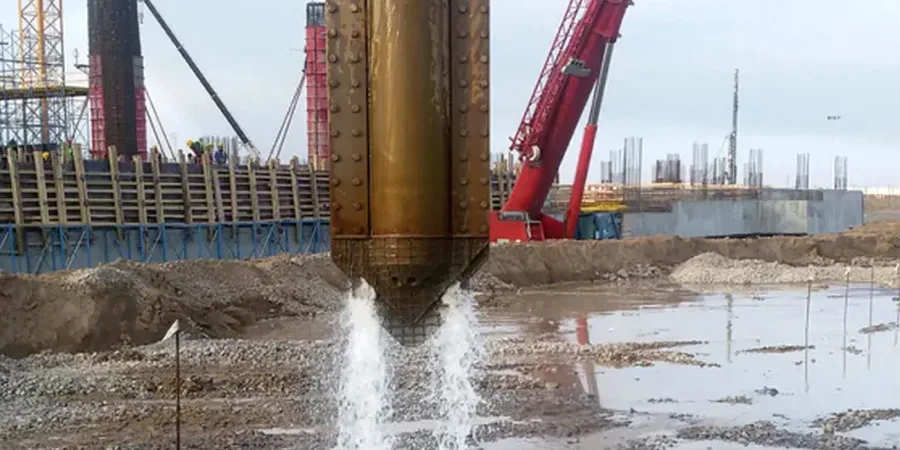
ASCE 7-22 and the California Building Code demand a rigorous approach to ground improvement in seismically active zones. In Sunnyvale the stakes are higher. Much of the city rests on Quaternary alluvial deposits drained by the Guadalupe River watershed, where loose granular layers and pockets of artificial fill create unpredictable settlement profiles. Standard compaction methods fail under these conditions. We offer vibrocompaction design that stabilizes the soil matrix at depth, increasing relative density above 70% to meet IBC bearing requirements. The process reduces post-construction settlement and mitigates liquefaction risk in a city where the water table sits barely 6 to 10 feet below the surface in many parcels. For sites near Moffett Park or along Mathilda Avenue, where fill thickness varies sharply, we often pair the design with a CPT test to map the subsurface before specifying probe spacing and energy input.
Densifying the upper 25 feet with vibrocompaction in Sunnyvale can raise SPT N-values from single digits to over 30 blows per foot.
Standards that apply
ASCE 7-22 Minimum Design Loads and Associated Criteria for Buildings and Other Structures, IBC 2024 (California Building Code, Title 24, Part 2), ASTM D1586 Standard Test Method for Standard Penetration Test (SPT) and Split-Barrel Sampling of Soils, ASTM D2487 Standard Practice for Classification of Soils for Engineering Purposes (Unified Soil Classification System), ASTM D4253/D4254 Standard Test Methods for Maximum Index Density and Unit Weight of Soils
Questions and answers
What does vibrocompaction design cost for a typical Sunnyvale lot?
For a standard commercial parcel between 5,000 and 20,000 square feet, the design package — including site investigation review, grid layout, and QC specifications — typically ranges from US$1,580 to US$4,510 depending on depth requirements and verification testing scope.
How deep can vibrocompaction treat the loose sands in Sunnyvale?
In the alluvial deposits south of Highway 101 we routinely treat down to 35 feet. North of 101, where Young Bay Mud appears, effective depth is often limited to 25–30 feet. The design accounts for the confining layer boundary mapped in USGS Quaternary geology sheets.
Does the City of Sunnyvale require post-treatment testing?
Yes. The Building Division expects verification testing — typically CPT or SPT — at a minimum of one test per 2,500 square feet of treated area. We include the testing grid and acceptance criteria directly in the design package so the special inspector has clear targets.
Can vibrocompaction replace deep foundations in Sunnyvale?
On sites with competent granular soils it often can. When the treatment raises relative density above 70% and post-treatment CPT confirms tip resistance above 120 kg/cm², spread footings become viable. We still recommend a comparative settlement analysis against a piled alternative before the owner commits.