← Home · Foundations

Raft/Mat Foundation Design in Sunnyvale, CA: Advanced Geostructural Solutions for Bay Area Soils

Together, we solve the challenges of tomorrow.

LEARN MORE →

A mid-rise residential development near the intersection of Mathilda Avenue and El Camino Real encountered a familiar Sunnyvale scenario: a site underlain by discontinuous lenses of compressible bay mud interbedded with stiff alluvial clays. Differential settlement was the primary concern identified during the preliminary soil exploration campaign. The structural engineer requested a raft/mat foundation design to bridge the variable stratigraphy, distributing column loads across an area large enough to reduce bearing pressures below the allowable limits established in the geotechnical report. The solution required a detailed understanding of subgrade reaction modulus variability, which we characterized through iterative plate-load correlations and consolidation settlement analyses. This type of integrated foundation approach is typical in Sunnyvale, where the transition between valley fill and bay plain deposits creates abrupt changes in soil stiffness over short distances, a condition that isolated footings cannot always accommodate without excessive differential movement.

A properly calibrated subgrade reaction modulus is the single most influential parameter in matching a mat foundation's structural response to Sunnyvale's heterogeneous subsurface conditions.

Methodology and scope

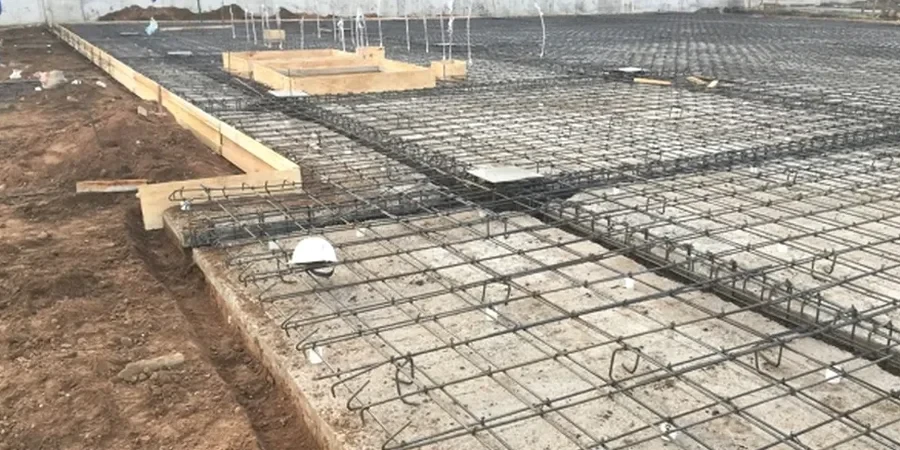
A common observation among geotechnical practitioners familiar with Sunnyvale is the pronounced seasonal volumetric change in the near-surface clay layers, which can impose uplift pressures on large-area foundations if not properly mitigated. Our raft/mat foundation design methodology begins with a rigorous assessment of the active zone depth and the plasticity characteristics of the upper 15 to 20 feet, typically classified as CH under the USCS. We incorporate a structural slab-on-grade configured as a rigid mat, often thickened at column locations and perimeter edges to resist punching shear and edge moments. The design integrates flexural analysis using finite element methods where the soil is modeled as a series of discrete springs calibrated to the modulus of subgrade reaction (ks) derived from in-situ testing. When dealing with the deeper compressible layers found east of Highway 85, we often complement the mat design with ground improvement techniques such as stone columns to homogenize the compressibility profile, thereby reducing long-term consolidation settlements to tolerable levels for the superstructure.
Raft/Mat Foundation Design in Sunnyvale, CA: Advanced Geostructural Solutions for Bay Area Soils
Technical reference image — Sunnyvale

Site-specific factors

With an estimated population of over 150,000 and located approximately 10 miles from the San Andreas Fault, Sunnyvale faces significant seismic risk that directly influences foundation design. A 2023 USGS update increased the probability of a damaging earthquake in the Bay Area to 72% over the next 30 years. For structures on raft/mat foundations, the primary concern during a seismic event is not just bearing capacity failure but the potential for excessive rocking and transient settlement in saturated granular layers. The IBC and ASCE 7-22 require explicit consideration of soil-structure interaction for structures on soft soils. A poorly designed mat can induce amplified ground motions into the superstructure if the foundation period aligns with the site's predominant spectral period. We methodically address this by performing site-specific response analysis to ensure the foundation system effectively decouples the structure from the most damaging ground frequencies, a critical step often overlooked in standard prescriptive designs.

Need a geotechnical assessment?

Reply within 24h.

Email: info@geotechnicalengineering1.biz

Watch the video

Technical parameters

ParameterTypical value
Maximum allowable total settlement (IBC 2021)1 inch (25 mm)
Maximum allowable differential settlement1/300 to 1/500 of span
Typical mat thickness range18 to 48 inches (450 to 1200 mm)
Typical subgrade reaction modulus (ks)50 to 150 pci for stiff clay
Soil bearing capacity (presumptive stiff clay)2,000 to 3,500 psf
Seismic site class (typical Sunnyvale basin)D or E (per ASCE 7-22)
Reinforcement yield strength (typical)Grade 60 (fy = 60 ksi)

Complementary services

01

Geotechnical-Structural Interface Analysis

This service establishes the critical design parameters for the raft/mat foundation by interpreting subsurface data specifically for soil-structure interaction modeling. We provide calibrated subgrade reaction profiles, allowable bearing pressures for strength and serviceability limit states, and anticipated total and differential settlement magnitudes. The analysis includes sensitivity checks on the influence zone depth, ensuring the mat's rigidity is adequate to span across the most critical subsurface anomalies identified during the site investigation phase.

02

Finite Element Mat Design and Detailing

We produce a fully detailed raft/mat foundation design incorporating staged construction analysis where necessary. The deliverables include mat thickness, reinforcement layout, and thickened zone specifications derived from three-dimensional finite element models that account for soil nonlinearity. The design explicitly addresses temperature and shrinkage reinforcement, punching shear at column interfaces, and the integration of construction joints. All output is formatted for direct incorporation into the structural drawing set, with a design basis report documenting compliance with the governing IBC and ACI 318 provisions.

Applicable standards

ASCE 7-22: Minimum Design Loads and Associated Criteria for Buildings and Other Structures, IBC 2021 (International Building Code), Chapter 18: Soils and Foundations, ACI 318-19: Building Code Requirements for Structural Concrete, ASTM D2487: Standard Practice for Classification of Soils for Engineering Purposes (Unified Soil Classification System), ASTM D1586: Standard Test Method for Standard Penetration Test (SPT) and Split-Barrel Sampling of Soils

Questions and answers

What is the typical cost range for a raft/mat foundation design in Sunnyvale?

For a typical residential or light commercial structure in Sunnyvale, the engineering design fee for a raft/mat foundation falls between US$920 and US$3,650. The final cost depends on the building footprint area, the complexity of the subsurface conditions, and the number of load combinations that require finite element analysis. Projects requiring soil-structure interaction modeling for seismic demands per ASCE 7-22 Chapter 19 will be at the upper end of this range.

When is a raft/mat foundation preferred over isolated footings in the Sunnyvale area?

A raft/mat foundation becomes the preferred solution when the allowable bearing capacity of the soil is relatively low (below 2,500 psf), when isolated footings would cover more than 50% of the building footprint, or when the subsurface profile includes highly compressible layers that could cause differential settlement between adjacent columns. In Sunnyvale, the transition zones between stiff alluvial deposits and softer bay mud frequently create these conditions, making mat foundations a common recommendation in geotechnical reports.

How does ASCE 7-22 seismic design affect the mat foundation thickness?

ASCE 7-22 requires that the foundation system be designed for the seismic forces transmitted from the superstructure, including overturning moments. For a raft/mat foundation, this often results in increased thickness at the perimeter and below shear walls to resist uplift and rotational demands. The mat must also maintain structural integrity under the inelastic displacement demands calculated for the Design Earthquake. In Sunnyvale's Site Class D and E profiles, the amplified spectral accelerations can increase base shear demands by 30% to 50% compared to a Site Class C reference, directly influencing the required reinforcement ratio and mat rigidity.

What soil parameters are most critical for a reliable raft/mat foundation design?

The three most critical parameters are the modulus of subgrade reaction (ks), the undrained shear strength of cohesive layers for bearing capacity checks, and the compression index (Cc) and recompression index (Cr) for consolidation settlement analysis. In Sunnyvale's alluvial and bay plain environment, the ks value can vary by a factor of three across a single building pad, so we rely on a combination of SPT N-values and laboratory consolidation tests to define a spatially representative subgrade model rather than using a single uniform value.
Location and service area

We serve projects in Sunnyvale and surrounding areas.

View larger map