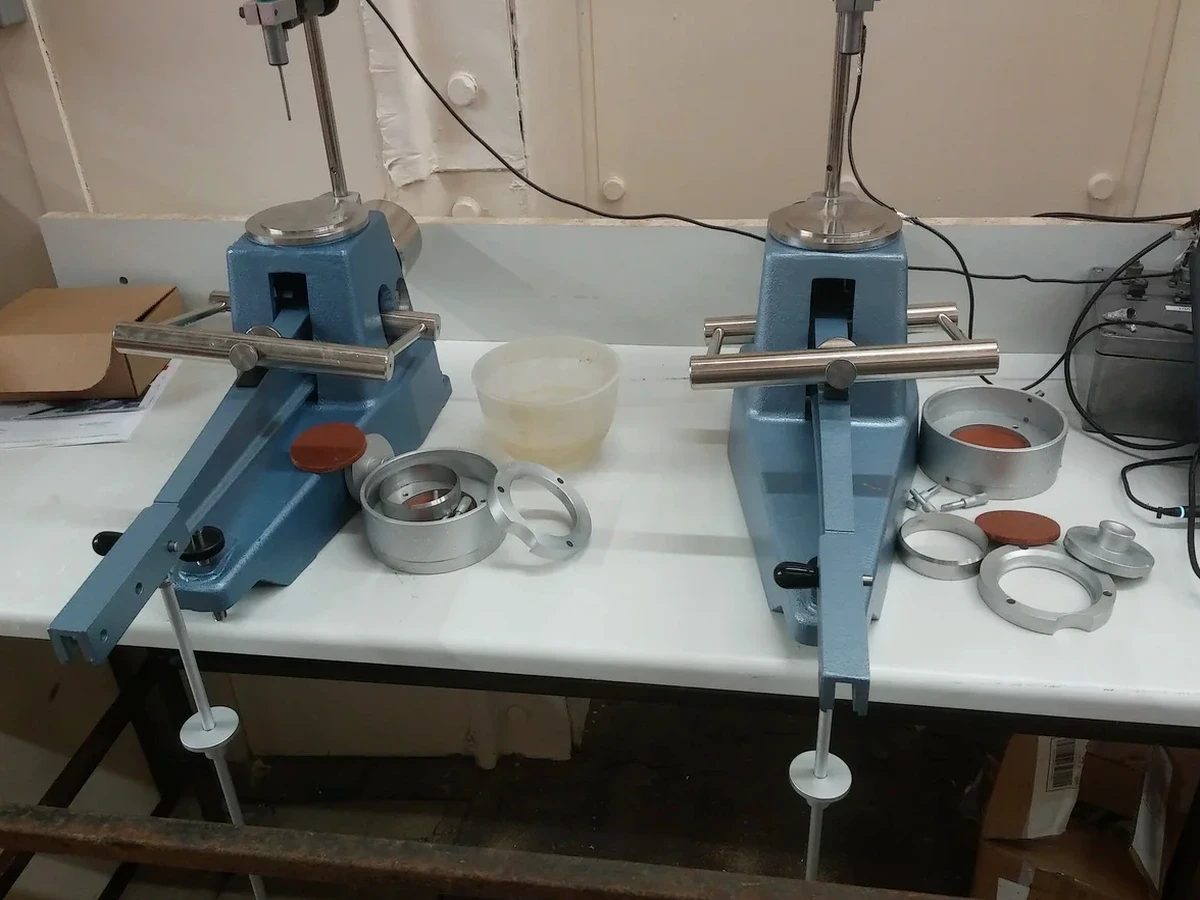
The Casagrande cup device arrives on site in Sunnyvale with the crank and grooving tool carefully packed in its field case. Technicians set up the brass cup and hard rubber base on a stable table inside the project trailer, then begin conditioning the fine-grained soil sample. Sunnyvale sits on the floor of the Santa Clara Valley, where the subsurface alternates between layers of silty clay, sandy clay, and occasional peat lenses left by the historic baylands. Atterberg limits testing quantifies how these soils behave as moisture content changes. The liquid limit test records the number of blows required to close a standard groove, while the plastic limit test involves hand-rolling threads of soil until they crumble at a 3 mm diameter. For Sunnyvale projects near the Guadalupe River or in the Moffett Park area, these values directly influence foundation depth recommendations and the selection of grain-size analysis for a complete soil classification. The plasticity index computed from these two boundaries tells us whether the native soil will shrink and swell with seasonal moisture fluctuations.
Atterberg limits are not abstract numbers. They predict whether a Sunnyvale clay will lift a slab or consolidate under fill.
Site-specific factors
Sunnyvale experienced significant ground shaking during the 1906 San Francisco earthquake, and even at a distance of roughly 40 miles from the San Andreas fault, the soft bay muds amplified seismic waves. Atterberg limits testing plays a direct role in evaluating which soil layers may be susceptible to cyclic softening. Fine-grained soils with high liquid limits and low plasticity indices near the A-line can lose strength when shaken, a phenomenon studied extensively by Seed and Idriss in the context of San Francisco Bay sediments. Misclassifying a high-plasticity clay as a silt because Atterberg limits were skipped can lead to underestimating foundation settlement. In the Sunnyvale industrial district east of Lawrence Expressway, where tilt-up concrete buildings sit on shallow footings, knowing the plasticity index of the upper five feet of soil is essential for calculating expected differential movement. The IBC and ASCE 7 both require site-specific geotechnical parameters for seismic design categories D and E, which apply throughout much of Sunnyvale. Without Atterberg data, the engineer cannot reliably assign a site class or select appropriate ground motion scaling factors.
Standards that apply
ASTM D4318: Standard Test Methods for Liquid Limit, Plastic Limit, and Plasticity Index of Soils, ASTM D2487: Standard Practice for Classification of Soils for Engineering Purposes (Unified Soil Classification System), ASCE 7 Chapter 20: Site Classification Procedure for Seismic Design, IBC Section 1613: Earthquake Loads - Site-Specific Geotechnical Report Requirements
Questions and answers
What do Atterberg limits actually measure in a Sunnyvale soil sample?
They measure the moisture contents at which a fine-grained soil transitions between solid, plastic, and liquid states. The liquid limit is the water content where a standard groove cut in a soil pat closes over 13 mm after 25 blows of the Casagrande cup. The plastic limit is the water content at which a rolled thread of soil crumbles at 3 mm diameter. The difference between the two is the plasticity index, which quantifies the range of moisture over which the soil behaves as a plastic material.
How much does Atterberg limits testing cost for a Sunnyvale project?
Atterberg limits testing typically ranges from US$60 to US$90 per sample when submitted individually. We offer reduced rates for bulk sample packages as part of a larger geotechnical investigation. The exact cost depends on whether we run a single-point liquid limit or a full multi-point determination.
Why are Atterberg limits important for foundation design in Sunnyvale?
Sunnyvale has extensive deposits of high-plasticity bay clays that shrink when dry and swell when wet. Atterberg limits quantify this behavior through the plasticity index. A PI above 25 generally indicates expansive potential, which influences footing depth, reinforcement requirements, and under-slab moisture conditioning. The limits also determine the USCS group symbol used in bearing capacity and settlement calculations.
Can you run Atterberg limits on samples with visible organic material?
Yes, but we follow a different preparation procedure. Organic-rich soils common in Sunnyvale near former marsh areas are oven-dried at 60°C instead of the standard 110°C to avoid burning off organic matter. We note this on the report. Highly organic soils such as peat may not yield meaningful Atterberg limits and are better evaluated through loss-on-ignition testing.
How long does it take to get Atterberg limits test results back?
Standard turnaround is 3 to 5 business days from sample receipt. We can offer a 24-hour expedited result for time-sensitive projects, such as during active grading when the contractor is waiting on classification to proceed with fill placement. Larger batches of 20 or more samples may require additional time depending on current lab workload.