← Home · Underground Excavations

Geotechnical Design of Deep Excavations in Sunnyvale

Together, we solve the challenges of tomorrow.

LEARN MORE →

Sunnyvale sits at an elevation of just 128 feet, but its subsurface tells a far more complex story. The city straddles the boundary between firm alluvial fan deposits and the compressible clays of the Santa Clara Valley groundwater basin. When a project requires an excavation deeper than 15 feet—common for the three-level underground parking structures now proliferating near Mathilda Avenue—the difference between a standard cut and a catastrophic collapse often comes down to the pre-construction analysis. Our team approaches each project with a detailed understanding of the local stratigraphy, where interbedded silts and clays can create perched water tables that surprise even experienced contractors. The 1989 Loma Prieta earthquake, which caused significant structural damage less than 15 miles from Sunnyvale, serves as a permanent reminder that temporary works must account for seismic lateral pressures. We integrate this seismic awareness into every shoring design, combining it with CPT testing to map the continuous soil profile before selecting the appropriate support system.

In Sunnyvale's transition zone between alluvium and bay mud, a 20-foot excavation can impose lateral deformations that exceed one inch within the first 48 hours if not properly braced.

Methodology and scope

The most persistent error we see in Sunnyvale is the assumption that a neighboring project's shoring plan is transferable. A successful soldier pile and lagging system on one side of El Camino Real can fail spectacularly on the other if the groundwater gradient differs by even two feet. The city's historical creeks, now culverted beneath the urban grid, left behind pockets of loose, saturated sand that behave unpredictably under surcharge loads. Our design methodology starts with a site-specific ground model built from laboratory testing of undisturbed samples, ensuring that the internal friction angle assigned to a dense layer is not inadvertently applied to a lens of bay mud. Where space constraints near adjacent buildings preclude conventional tiebacks, we analyze the feasibility of internal bracing or top-down construction methods. For projects near the Sunnyvale Baylands, where organic soils extend to significant depths, we often recommend a pre-construction vibrocompaction program to mitigate differential settlement before excavation even begins, a sequence that saves both time and structural integrity.
Geotechnical Design of Deep Excavations in Sunnyvale
Technical reference image — Sunnyvale

Site-specific factors

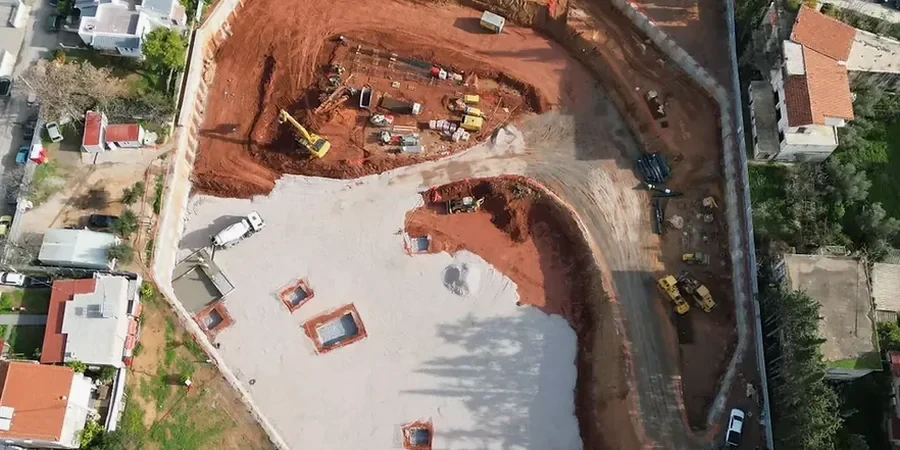
A hydraulic excavator with a long-reach boom working a deep cut in Sunnyvale's compacted alluvium can mask a dangerous reality: the soil face may stand vertically without visible distress for hours, then ravel suddenly as pore pressures equalize. This delayed failure mechanism is particularly acute in the cohesive silts found east of Lawrence Expressway. Managing this risk requires real-time verification that the as-built conditions match the design assumptions. We specify observational method protocols where inclinometers and piezometers feed data back to the design engineer daily. If lateral movements approach the pre-determined threshold—often set at 0.5 inches for critical adjacent utilities—the support system must stiffen immediately. The groundwater control plan is equally critical; a single unsealed monitoring well abandoned decades ago can provide a direct hydraulic connection between the excavation base and a deeper artesian zone, leading to a sudden base blowout that no amount of dewatering can reverse.

Need a geotechnical assessment?

Reply within 24h.

Email: info@geotechnicalengineering1.biz

Technical parameters

ParameterTypical value
Design ApproachASCE 7-22 Load Combinations, IBC 2021 Section 1806
Soil Strength InputDrained and undrained parameters per ASTM D4767 (Triaxial)
Groundwater ModelingSteady-state and transient seepage analysis
Shoring Systems AnalyzedSoldier piles, secant piles, diaphragm walls, soil nailing
Settlement Prediction3D finite element method (FEM) for adjacent structures
Seismic CoefficientMapped Ss and S1 per USGS for Sunnyvale coordinates
Basal StabilityFactor of safety against heave per Terzaghi (1943)

Complementary services

01

Shoring System Design

Full structural design of cantilever, anchored, and braced excavation walls. We size steel soldier piles per AISC 360, determine embedment depths for passive resistance, and detail the waler beam connections that transfer earth pressures to the bracing system.

02

Groundwater Control Plans

Design of deep well, wellpoint, and eductor dewatering systems tailored to Sunnyvale's layered aquifer system. Our plans include settlement analysis to prove that drawdown will not consolidate the clays beneath adjacent foundations.

03

Finite Element Modeling

2D and 3D finite element analysis using PLAXIS or equivalent software to predict excavation-induced ground movements. We model the construction sequence stage by stage, capturing the stress path dependency of the soil behavior.

04

Instrumentation and Monitoring Specifications

Development of monitoring plans specifying inclinometer locations, survey point arrays, and automated readout thresholds. We define the actionable limits that trigger contingency measures if movement exceeds predicted values.

Applicable standards

IBC 2021 Chapter 18, ASCE 7-22 Section 12.8, ASTM D2487 (Unified Soil Classification System), OSHA 29 CFR Part 1926 Subpart P (Excavations), Caltrans Standard Specifications Section 19

Questions and answers

At what depth does IBC 2021 require a designed shoring system in Sunnyvale?

IBC Section 1806.1 requires design of earth retaining systems for excavations deeper than 5 feet. For cuts exceeding 20 feet, Section 1810.3 mandates a registered design professional to prepare the shoring plans. In Sunnyvale, where groundwater is often encountered within the top 12 feet, we typically design a supported system for any cut deeper than 8 feet to manage hydrostatic pressures safely.

How do you account for the risk of liquefaction during a deep excavation?

We evaluate the cyclic stress ratio using the Seed and Idriss simplified procedure adapted for temporary works. If the factor of safety against liquefaction falls below 1.1 for the loose sand layers exposed in the excavation face, we redesign the support system to retain the fluid-like soil pressures post-liquefaction or specify ground improvement such as stone columns prior to cutting.

What is the typical cost range for a deep excavation design package in Sunnyvale?

A complete geotechnical design package for a deep excavation in Sunnyvale, including shoring calculations, dewatering plan, and FEM settlement analysis, typically ranges from US$1,950 to US$8,950. The final fee depends on the excavation depth, the number of adjacent structures requiring protection, and the complexity of the groundwater control system.

Can you design an excavation support system that allows top-down construction?

Yes. Top-down construction is often the preferred method on congested Sunnyvale sites because the permanent slabs act as lateral bracing during excavation. We design the temporary plunge columns and the connection details between the diaphragm wall and the floor slabs, analyzing the arching of earth pressures as the excavation proceeds beneath the completed structure.
Location and service area

We serve projects in Sunnyvale and surrounding areas.

View larger map