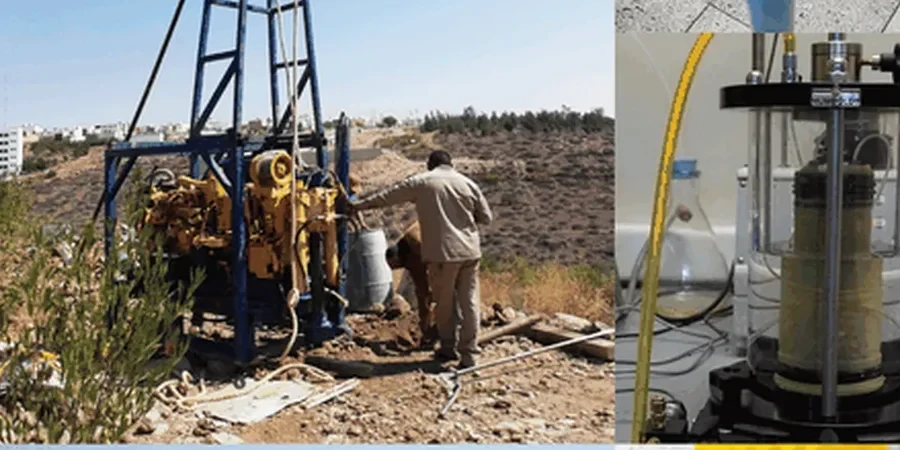
Sunnyvale sits on a fascinating geological boundary where the alluvial fans of the Santa Cruz Mountains thin out into the deep bay mud of the Santa Clara Valley. The soil profile here shifts dramatically within a few hundred feet: dense Pleistocene gravels near the foothills give way to soft, compressible Holocene clays toward the bay, with groundwater often just three to six feet below grade. A soil mechanics study in Sunnyvale has to reconcile these abrupt transitions, because a foundation design that works perfectly north of El Camino Real can encounter excessive settlement a mile south. The area’s high seismic hazard — the city lies roughly seven miles from the San Andreas Fault and directly atop the Cupertino Basin — adds a layer of complexity that standard bearing capacity checks do not address. Our laboratory in the region processes undisturbed Shelby tube samples and remolded specimens according to ASTM D2487 and D1586 protocols, delivering the shear strength parameters, consolidation data, and compaction curves that structural engineers need before committing to a foundation type. For sites where deep liquefaction assessment is required, we often pair the soil mechanics study with a CPT test to obtain a continuous stratigraphic profile without sample disturbance in the saturated silty layers.
Two sites separated by a single Sunnyvale block can differ in allowable bearing pressure by a factor of three — that is the reality of the alluvial-to-bay-mud transition.
Method and coverage
A soil mechanics study in Sunnyvale typically begins with a truck-mounted CME-75 drill rig advancing hollow-stem augers through the near-surface fill, with Standard Penetration Tests taken every five feet per ASTM D1586. The split-spoon sampler recovers disturbed samples for classification, while thin-walled Shelby tubes capture the undisturbed cores needed for triaxial and consolidation testing. In the laboratory, specimens undergo unconsolidated-undrained triaxial compression to measure the undrained shear strength of saturated clays, a parameter that dictates the allowable bearing pressure for mat foundations in the lowland areas. Consolidation tests run for up to ten days to determine the compression index and coefficient of consolidation, because even a half-inch of differential settlement across a tilt-up concrete warehouse in Sunnyvale can crack wall panels and misalign overhead crane rails. The grain size distribution, Atterberg limits, and moisture-density relationship round out the physical characterization, giving the project geotechnical engineer a complete picture of the soil’s mechanical behavior under load.
Site-specific factors
The contrast between the Cherry Chase neighborhood and the industrial corridor near Moffett Field illustrates why a soil mechanics study in Sunnyvale must be site-specific rather than extrapolated from regional maps. Cherry Chase sits on older alluvial deposits with medium-stiff clays and sands that generally offer adequate bearing, though expansive smectite pockets can appear in the weathered zone. Moffett Field, built largely on engineered fill over historic marshland, presents a different challenge: thick layers of compressible organic silt and peat that continue consolidating decades after placement, with a groundwater table that rises to within two feet of the surface in wet winters. One commercial project we reviewed in the Moffett Park area had specified a shallow footing design based on a geotechnical report from a site half a mile away; the actual subgrade showed undrained shear strengths below 300 psf in the upper six feet. The redesign required a deep pile system penetrating into the Pleistocene layer at approximately forty feet. Sunnyvale’s clay sensitivity — the loss of strength upon remolding — also matters for excavation stability, particularly where bay mud is exposed in open cuts during the rainy season.
Standards that apply
IBC 2024 (adopted by City of Sunnyvale with California amendments), ASCE 7-22 for seismic ground motion parameters and site classification, ASTM D1586 standard penetration test procedure, ASTM D2487 Unified Soil Classification System, ASTM D4767 consolidated-undrained triaxial compression test, ASTM D2435 one-dimensional consolidation properties
Questions and answers
How does a soil mechanics study differ from a standard geotechnical investigation?
A soil mechanics study focuses specifically on the physical and mechanical properties of the soil — shear strength, compressibility, permeability, and compaction behavior — under controlled laboratory conditions. A broader geotechnical investigation includes the field drilling and sampling plus the engineering recommendations. The soil mechanics component provides the quantitative parameters (friction angle, cohesion, compression index) that a structural engineer uses directly in foundation calculations.
How deep do you typically drill for a soil mechanics study in Sunnyvale?
Most borings extend to between 30 and 50 feet, which is sufficient to penetrate the compressible Holocene clays and reach the stiffer Pleistocene alluvium that serves as a competent bearing stratum. For taller structures or projects near the bay where the soft clay is thicker, we may extend borings to 80 feet or more to evaluate deep foundation options.
What is the typical turnaround time for laboratory testing?
Basic classification tests — grain size, Atterberg limits, and moisture content — can be completed within five to seven business days after samples arrive at the lab. Consolidation and triaxial shear tests require longer, typically two to three weeks, because of the time needed for specimen saturation and staged loading. We offer preliminary bearing capacity estimates based on SPT correlations immediately after fieldwork so that design work can proceed in parallel.
What does a soil mechanics study in Sunnyvale typically cost?
A complete soil mechanics study in Sunnyvale, including two borings to 40 feet, SPT sampling, Shelby tubes, consolidation and triaxial testing, and a full geotechnical report with foundation recommendations, generally runs between US$2,790 and US$5,950 depending on the number of laboratory tests required and site access conditions. Projects requiring deeper borings, liquefaction analysis, or additional chemical testing fall toward the upper end of that range.