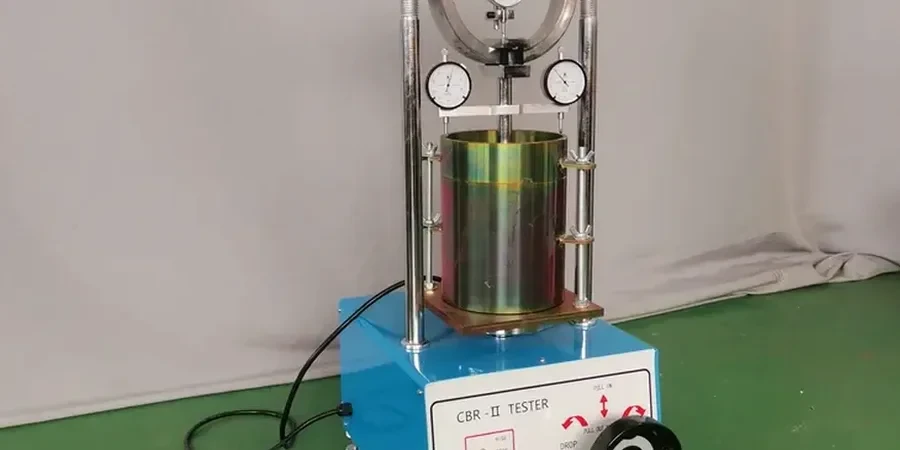
Sunnyvale sits on the alluvial fan of the Santa Clara Valley, where subsurface conditions can shift from dense gravelly deposits near the Bay to expansive clay lenses further inland. We see it on nearly every project: a contractor assumes uniform bearing capacity, then hits a pocket of silty clay that fails under load. The laboratory CBR test takes that guesswork out of the equation. By measuring the penetration resistance of a compacted sample under controlled moisture and density conditions, our lab gives engineers the empirical value they need to size pavement sections per Caltrans standards. It is not just a number. It is the difference between a parking lot that lasts 5 years and one that holds up for 25. For projects along Mathilda Avenue or near the Moffett Park corridor, where heavy delivery trucks are part of daily traffic, knowing the soaked CBR value becomes a design requirement, not a checkbox. We run the test in our accredited lab using surcharge weights that simulate actual pavement overburden, and we report results within the timelines a fast-moving Silicon Valley construction schedule demands. When the subgrade is questionable, pairing the CBR with a grain-size analysis helps confirm the classification before committing to a structural section.
A soaked CBR value below 3% in Sunnyvale's Bay Mud zones means you are designing for a floating pavement structure, not a conventional section.
Site-specific factors
ASTM D1883 and the Caltrans Highway Design Manual both require soaked CBR values for pavement design in California, and Sunnyvale's shallow groundwater in the northern part of the city makes this requirement particularly relevant. If a lab runs the CBR test at field moisture without soaking, the resulting number can be dangerously optimistic. We have seen projects where an unsoaked CBR of 25% dropped to 4% after saturation, completely invalidating the pavement structural design. The risk compounds when the subgrade contains fines that are susceptible to capillary rise: moisture migrates upward from the water table into the pavement support layer, reducing bearing capacity over time even without direct infiltration. For rigid pavements on grade, a low CBR translates into excessive slab curling stresses and joint faulting. For flexible pavements, it means deeper rutting and fatigue cracking within the asphalt layers. The fix is not complicated: test the worst-case scenario, design for it, and if the soaked CBR is below 5%, consider stabilization with lime or cement, or replace the upper subgrade with a select fill that meets Caltrans Class 2 aggregate base specifications.
Standards that apply
ASTM D1883-21 (Standard Test Method for California Bearing Ratio of Laboratory-Compacted Soils), ASTM D698-12 (Standard Test Methods for Laboratory Compaction Characteristics of Soil Using Standard Effort), ASTM D1557-12 (Standard Test Methods for Laboratory Compaction Characteristics of Soil Using Modified Effort), Caltrans Highway Design Manual, Chapter 600 (Pavement Engineering), AASHTO T 193-13 (The California Bearing Ratio)
Questions and answers
What does a laboratory CBR test cost in Sunnyvale?
A standard soaked CBR test on a single specimen typically ranges from US$120 to US$180, depending on whether the Proctor compaction curve is included or if we are testing multiple compaction efforts. A full 3-point CBR with corresponding Proctor data generally runs toward the upper end of that range.
How long does a CBR test take to complete?
The test itself takes 4 to 5 working days from sample receipt. That includes the time needed for compaction, the mandatory 96-hour soaking period, and the penetration test. We can expedite reporting for tight construction schedules when necessary.
Do I need a soaked or unsoaked CBR for my project?
For pavement design in Sunnyvale, Caltrans and most city engineering departments require the soaked CBR value. The 96-hour saturation simulates the worst-case subgrade moisture condition over the pavement's service life. An unsoaked test may be useful for comparison, but it should never be the sole basis for structural design.
What CBR value is considered acceptable for a road subgrade?
For flexible pavement design, a soaked CBR of 5% or higher is generally considered acceptable for light traffic. Values between 10% and 20% indicate a good subgrade that reduces required asphalt thickness. Below 3%, the subgrade is considered very poor and typically requires stabilization, a thicker aggregate base, or a geogrid-reinforced section.