← Home · Investigation

Exploratory Test Pit Services in Sunnyvale

Together, we solve the challenges of tomorrow.

LEARN MORE →

Sunnyvale's rapid shift from orchards to aerospace and tech campuses has left a legacy of mixed fills and buried agricultural soils that standard borings often miss. The valley's alluvial fan deposits compress irregularly, and even a small lens of silty clay can derail a shallow foundation design. That's why an exploratory test pit in Sunnyvale still matters more than many engineers assume. We open the ground in the exact spot where the footing will sit, log the sequence with our geologists, and pull undisturbed samples right from the face. When the pit is combined with a grain size analysis on key strata, you get a direct visual correlation that SPT blow counts alone can't give you. It's old-school field work backed by an ISO/IEC 17025-accredited lab, and we run it tight to ASTM D2487 so the Unified Soil Classification symbols on the log mean exactly what they're supposed to.

A test pit gives you the one thing a boring never will: an uninterrupted view of the soil that your footing will actually bear on.

Methodology and scope

In Sunnyvale, we've seen too many trench logs that call everything 'sandy clay' because no one looked at the fines fraction. That habit causes problems when the water table rises to within six feet of grade in winter, which is common on the northern edge of town near the bay. Our exploratory test pit protocol skips that shortcut. We describe color, moisture, consistency, and structure right at the face, bag samples for atterberg limits verification, and photograph every lift before the backhoe moves. If the pit reveals uncontrolled fill with brick fragments and wood debris — a frequent discovery in neighborhoods platted before 1960 — we flag it immediately so the structural engineer can adjust the bearing depth. A test pit also lets us measure infiltration rates with a double-ring infiltrometer right in the excavation, saving a separate trip for permeability data. The result is a single field day that produces a defensible stratigraphic column and enough lab data to satisfy the local building official.
Exploratory Test Pit Services in Sunnyvale
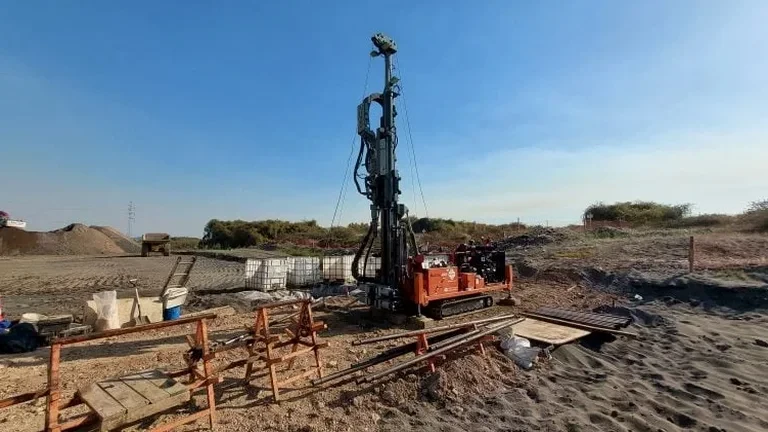
Technical reference image — Sunnyvale

Site-specific factors

Sunnyvale sits at roughly 125 feet above sea level, but the groundwater table in the shallow aquifer can fluctuate ten feet between August and February. A test pit excavated in dry September conditions can look perfectly stable, then collapse overnight if the crew doesn't account for seepage at the gravel-sand interface. That interface is our biggest concern in exploratory test pit work here: it's where the coarse-grained lenses that feed the Stevens Creek alluvial fan daylight into the finer bay muds. We've had pits near the Moffett Field boundary where water entered at less than four feet, requiring a sump pump just to keep the floor dry enough for sampling. When that happens, we switch to a CPT test for the deeper profile, using the test pit data as a ground-truth calibration point. The combination avoids the risk of a partial collapse that could injure a technician or compromise the sample integrity.

Need a geotechnical assessment?

Reply within 24h.

Email: info@geotechnicalengineering1.biz

Technical parameters

ParameterTypical value
Typical pit depth8 to 14 ft
Bucket width24 to 36 in
Sampling methodBlock, Shelby tube, or bulk bag
Logging standardASTM D2488 / D2487
Backfill specificationCompacted lift < 12 in, > 95% relative compaction
Shoring required beyond5 ft per OSHA Subpart P
Lab turnaround3-5 business days

Complementary services

01

Standard test pit package

One-day field crew with a tracked excavator, continuous SPT sampling at the pit floor, full USCS logging, high-resolution photographs, and a stamped report with bearing capacity recommendations per IBC Chapter 18.

02

Infiltration testing add-on

Double-ring infiltrometer test performed inside the open pit to satisfy Santa Clara County stormwater requirements for bioretention areas and dry wells.

Applicable standards

ASTM D2488 (visual-manual soil description), ASTM D2487 (Unified Soil Classification System), OSHA 1926 Subpart P (trenching and excavation safety)

Questions and answers

How much does an exploratory test pit in Sunnyvale cost?

Most residential and light commercial test pits in Sunnyvale run between US$550 and US$820, assuming reasonable access for a rubber-tire backhoe and no unexpected utility conflicts. The final number depends on depth, number of samples collected, and whether we run lab tests like sieve analysis or Atterberg limits.

How deep can you go with a test pit?

In Sunnyvale's alluvial soils, we routinely excavate to 14 feet. Beyond that, OSHA Subpart P requires engineered shoring or a benched excavation, which adds time and cost. For depths greater than 20 feet, we usually recommend a drilled boring instead.

Do I need a permit for a test pit?

Generally yes. Sunnyvale requires a grading permit if the excavation exceeds 50 cubic yards, but most single test pits fall below that threshold. We still file a USA North 811 ticket at least two working days before digging and notify the city if we're working in the public right-of-way.

What's the difference between a test pit and an SPT boring?

A boring gives you a two-inch-diameter column of disturbed soil; a test pit gives you a full-width exposure where you can see layering, fissures, and inclusions that a split spoon misses. We use both. The pit is better for visual logging and bulk sampling; the boring is better for deeper profiles and standard penetration resistance.
Location and service area

We serve projects in Sunnyvale and surrounding areas.

View larger map