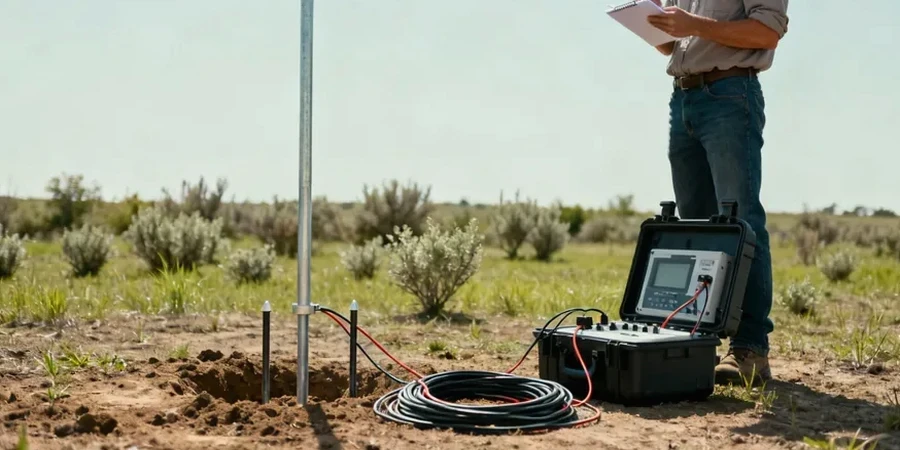
Nearly every geotechnical investigation in Sunnyvale eventually runs into the question of groundwater and soil salinity. We see it repeatedly in projects near Moffett Field and along the 237 corridor: conventional borings give you a point measurement, but they don’t show how the conductive plume migrates laterally through the old bay mud. Electrical resistivity fills that gap. Our team uses 4-electrode Schlumberger arrays to map vertical resistivity profiles that distinguish freshwater sand lenses from the brackish clays that dominate the Santa Clara Valley subsoil. It’s a method that saves drill footage and flags trouble zones before the excavator ever hits the site. For deeper targets below 30 m, we often pair VES with a seismic refraction line to cross-validate the bedrock depth interpreted from the resistivity inversion.
Electrical resistivity in Sunnyvale is less about finding rock and more about mapping the invisible boundary between fresh and saline pore water at depth.
Questions and answers
What does a VES survey typically cost for a Sunnyvale residential lot?
For a standard single-family lot investigation with two to three sounding points and AB/2 max spread around 60 m, we typically see costs between US$600 and US$1.100. The final number depends on access constraints, the number of soundings, and whether we need to coordinate with utility clearance on busy streets.
How deep can electrical resistivity see in Sunnyvale’s soil conditions?
In the conductive bay mud environment, practical depth of investigation with a surface Schlumberger array is roughly 20 to 25 percent of the maximum current electrode separation. We routinely reach 40 to 60 m by extending AB/2 to 150 m, which is enough to reach the Pleistocene gravel aquifer beneath most of Sunnyvale.
Does VES replace soil borings?
No, it complements them. Resistivity gives you a continuous vertical profile of formation electrical properties, but it does not directly measure strength or soil classification. We always calibrate VES inversion models against at least one SPT or CPT boring to tie resistivity boundaries to lithology and N-values.
How long does a VES survey take on site?
A typical two- to three-sounding survey on a Sunnyvale commercial lot takes one field day for setup, measurement, and breakdown. Data processing and inversion modeling add another two to three working days before the draft report is ready for review.
Is resistivity affected by buried utilities or pavement?
Absolutely. Buried steel pipes, reinforced concrete, and overhead power lines all introduce noise or shunt current. Before mobilizing, we review utility as-builts and mark out clear electrode spreads. In high-interference zones along El Camino Real or near substations, we adjust array orientation or use higher stacking counts to improve signal-to-noise ratio.