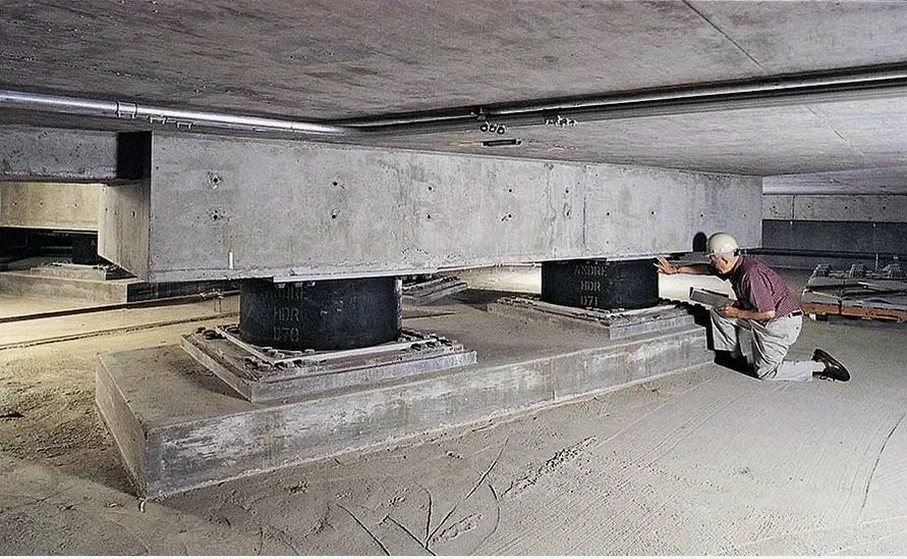
Sunnyvale sits on deep alluvial deposits at the southern edge of San Francisco Bay, where groundwater is often within 10 feet of the surface. ASCE 7-22 and the California Building Code mandate rigorous seismic design here, and for buildings with Risk Category III or IV, base isolation frequently becomes the most rational solution. The site class in much of the city falls between D and E: soft clays and loose sands that amplify ground motion and increase spectral acceleration demands. Our team supports the structural engineer with the geotechnical parameters the isolation system needs: soil-structure interaction stiffness, near-fault effects (the Hayward fault is 12 miles east, San Andreas 8 miles west), and site-specific response spectra. The seismic microzonation work already completed for Santa Clara County gives us a solid starting point, and we refine it with project-specific borings and lab testing.
Base isolation isn't just rubber and steel. If you get the soil stiffness wrong by 20%, the period shift can move the structure into a worse spectral acceleration band.
Questions and answers
What does base isolation seismic design cost for a Sunnyvale project?
The geotechnical investigation and dynamic testing package for a base isolation design typically runs between US$4,820 and US$8,150, depending on the number of borings, depth, and lab tests required. This is the geotechnical portion only. The isolation system hardware and structural design are separate costs handled by the structural engineer and isolator manufacturer.
How deep do borings need to go for base isolation design?
ASCE 7 requires borings to extend at least 30 feet below the foundation level, or to rock if shallower. In Sunnyvale, where bedrock can be over 500 feet deep, we typically drill to 100 feet for isolation projects to capture the full soil column that influences long-period motion. We also run a downhole shear wave velocity profile in at least one boring per site.
Can base isolation be retrofitted to an existing building in Sunnyvale?
Yes, but it is more complex than new construction. The existing foundation must be evaluated for jacking loads, and temporary shoring is required. We have supported retrofit designs where isolators were installed by cutting columns above the foundation and inserting bearings. The geotechnical side involves assessing the existing foundation's capacity and settlement behavior under the new load path.
What soil parameters does the isolator manufacturer need from us?
The manufacturer needs the site-specific response spectrum at the foundation level, equivalent soil spring stiffnesses (horizontal and rotational), and an estimate of differential settlement under the isolator layout. We offer these from the site response analysis and settlement calculations, along with the shear modulus degradation and damping curves from lab testing.