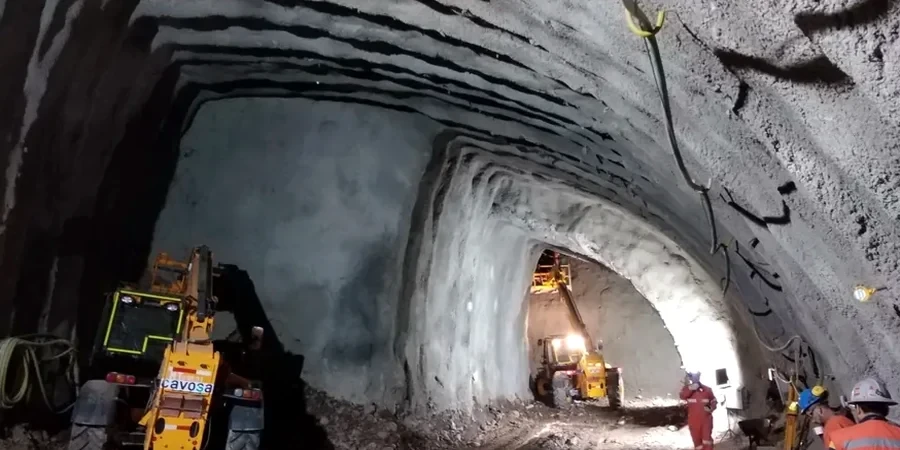
Sunnyvale sits squarely on the Santa Clara Valley floor, where the subsurface profile is dominated by Holocene alluvium—layers of soft, compressible Bay Mud interbedded with loose to medium-dense sands. ASCE 7-22 Section 11.4.8 and the California Building Code (CBC) require a site-specific response analysis for deep excavations in these conditions, and that starts with a solid geotechnical analysis for soft soil tunnels. In our knowledge, tunnel alignment through the city’s tech campus expansions often crosses saturated silty clays with undrained shear strengths below 500 psf near the surface. Before an EPB or slurry TBM even enters the discussion, the ground needs to be characterized with high-resolution stratigraphy and pore pressure data. We correlate the Standard Penetration Test (ASTM D1586) with cone penetration results and laboratory consolidation curves to anticipate face instability and surface settlement. For projects near the Guadalupe Slough, where the soft compressible layer exceeds 40 feet, we often recommend coupling the tunnel investigation with a deep excavation monitoring program to protect adjacent structures during shaft construction.
In Sunnyvale’s Bay Mud, undrained shear strength can drop below 300 psf, demanding continuous face support and real-time settlement monitoring during tunneling.
Method and coverage
The core of our field campaign in Sunnyvale relies on a tracked CPT rig with a 20-ton capacity, equipped with a piezocone module that records tip resistance, sleeve friction, and dynamic pore pressure (u2) at 2-cm intervals. What makes this equipment essential is its ability to push through the stiff desiccated crust—common under the city’s older industrial parks—and into the underlying soft clay without losing resolution. The pore pressure dissipation tests we run at multiple depths let us estimate the coefficient of consolidation (cv) in situ, a parameter that governs the time-rate of settlement during tunnel boring. We complement the CPT with thin-wall Shelby tube sampling (ASTM D1587) to recover undisturbed specimens of the soft soil for laboratory strength and compressibility testing. The data feeds directly into PLAXIS 3D models used to simulate tunnel face stability under groundwater pressures that, in Sunnyvale, can rise to within 5 feet of the finished grade during wet winters. A typical investigation for a 12-foot-diameter utility tunnel involves three to five CPT soundings spaced along the alignment, each reaching 20 feet below the proposed invert—a depth that often encounters the transition to the stiffer Pleistocene alluvium.
Site-specific factors
Sunnyvale’s Mediterranean climate produces stark seasonal contrasts that directly influence tunnel risk: six months of near-total drought followed by atmospheric river events that can saturate the upper soil column in 48 hours. The soft clay beneath the city doesn’t drain quickly—its low permeability traps water, and when a tunnel face advances through it during the rainy season, the undrained loading can trigger rapid face collapse or blowout if the face pressure isn’t carefully controlled. We’ve seen pore pressure spikes of 8–12 psi in the upper 15 feet after a single heavy storm, enough to reduce effective stress and halve the already marginal stand-up time. Another risk unique to Sunnyvale is the presence of discontinuous sand lenses within the Bay Mud; these can act as confined aquifers that release water into the excavation, causing internal erosion and sinkhole development at the surface. A geotechnical analysis for soft soil tunnels here must model both the steady-state groundwater table and the transient response to storm recharge, or the settlement trough above the tunnel can exceed 3 inches and damage nearby infrastructure.
Standards that apply
ASTM D1586: Standard Test Method for Standard Penetration Test (SPT) and Split-Barrel Sampling of Soils, ASTM D2487: Standard Practice for Classification of Soils for Engineering Purposes (Unified Soil Classification System), ASCE 7-22: Minimum Design Loads and Associated Criteria for Buildings and Other Structures, Chapter 11, IBC 2021: International Building Code, Section 1803 Geotechnical Investigations, Caltrans Trenching and Shoring Manual, Chapter 9: Soft Ground Tunneling
Questions and answers
What depth of soft soil is typically encountered in Sunnyvale, and how does it affect tunnel design?
In central and northern Sunnyvale, the Holocene Bay Mud extends between 30 and 55 feet below grade, underlain by Pleistocene alluvium. A tunnel invert placed within the soft clay requires continuous face support—either earth pressure balance or slurry—and a lining designed for long-term consolidation loads as excess pore pressures dissipate over years.
How do you estimate the coefficient of consolidation (cv) for tunnel settlement predictions?
We run piezocone dissipation tests at the proposed tunnel depth, recording the time for the pore pressure to decay to 50% of its initial value (t50). That field measurement is then combined with laboratory oedometer tests on undisturbed samples to derive a cv profile that accounts for the soil’s stress history and overconsolidation ratio.
What is the typical cost range for a geotechnical analysis for soft soil tunnels in Sunnyvale?
For a tunnel alignment investigation in Sunnyvale’s soft soil, project costs generally range from US$3,980 for a targeted CPT and laboratory program on a short utility bore to US$18,390 for a comprehensive campaign that includes multiple CPT soundings, Shelby tube sampling, consolidation and triaxial testing, and 3D finite element settlement modeling.
Does the City of Sunnyvale require a specific geotechnical report format for tunnel projects?
Yes—the City’s Public Works Department requires a Geotechnical Baseline Report (GBR) and a Geotechnical Data Report (GDR) that follow the guidelines of the International Tunneling Association (ITA) and include site-specific seismic parameters per ASCE 7-22. The report must address groundwater conditions, face stability analysis, and settlement predictions before a tunnel permit is issued.