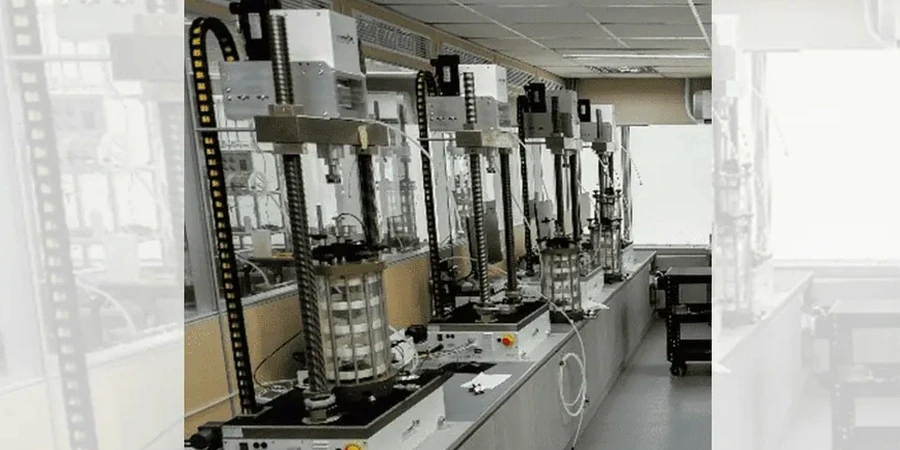
Silicon Valley’s geology doesn’t get simpler when you move south of the Bay into Sunnyvale. The transition from deep alluvial fans to the younger bay mud deposits along the Guadalupe Slough creates a subsurface that confuses standard bearing capacity assumptions. We’ve pulled cores near Moffett Park where a stiff sandy lean clay at 12 feet sat directly above a normally consolidated silty clay that lost 40 percent of its undrained strength when we ran a full triaxial suite. That’s the kind of detail you don’t catch with a pocket penetrometer. For the 152,000 people living in a city where the water table sits barely six feet down in the summer, a proper triaxial test isn’t optional—it’s the difference between a footing that settles a quarter inch and one that tilts toward the storm drain after two rainy seasons.
A 28-degree effective friction angle from a CU triaxial in Sunnyvale clay is worth more than any textbook correlation when you’re three feet above the water table.
Site-specific factors
North of Highway 101, near the Guadalupe Slough, the risk profile shifts dramatically compared to the Cherry Chase neighborhood on the old orchard terraces. Slough-side sites sit on Holocene bay mud with organic content that can exceed 5 percent, and the undrained shear strength from a UU triaxial on those samples sometimes reads below 300 psf at 10 feet deep. That’s a number that demands either deep foundations or a solid ground improvement strategy. On the orchard side, you’re looking at Pleistocene alluvium that’s been desiccated and overconsolidated, where a triaxial test might show an effective cohesion of 400 psf and a friction angle of 32 degrees—good ground, but still sensitive to moisture changes. We’ve seen projects where skipping the slope stability analysis that feeds directly from triaxial data led to a retaining wall tilt on a 12-foot cut near Stevens Creek. In Sunnyvale, the soil strength numbers you plug into your model have to come from actual lab curves, not from a generic correlation table.
Standards that apply
ASTM D4767-11: Standard Test Method for Consolidated Undrained Triaxial Compression Test for Cohesive Soils, ASTM D2850-15: Standard Test Method for Unconsolidated-Undrained Triaxial Compression Test on Cohesive Soils, ASTM D2487-17: Standard Practice for Classification of Soils for Engineering Purposes (Unified Soil Classification System), ASCE 7-22: Minimum Design Loads and Associated Criteria for Buildings and Other Structures, 2022 California Building Code (CBC), Title 24, Part 2 (based on IBC 2021)
Questions and answers
What’s the difference between a UU and a CU triaxial test for my Sunnyvale project?
A UU (unconsolidated-undrained) test per ASTM D2850 gives you the undrained shear strength of a clay in its in-situ state, without allowing drainage during shearing. It’s a quick way to get a total-stress cohesion value for short-term bearing capacity or slope stability during construction. A CU (consolidated-undrained) test per ASTM D4767 consolidates the specimen first, then shears it undrained while measuring pore pressure. That gives you both total and effective stress parameters—the drained friction angle and cohesion you need for long-term settlement and stability analysis. For most Sunnyvale sites with high groundwater, we recommend at least one CU suite if you’re designing permanent foundations or retaining structures.
How much does a triaxial test program cost in the Bay Area?
A full triaxial testing program on a Sunnyvale project typically runs between US$1,640 and US$2,920, depending on the number of specimens, whether you need UU or CU tests, and the confining pressure range. A standard three-specimen CU suite with pore pressure measurement starts at the lower end, while a program covering multiple depths or including both UU and CU phases moves toward the upper end. This includes specimen trimming, saturation, shearing, and the interpretive report with Mohr-Coulomb parameters.
How many triaxial specimens do I need per boring?
There’s no fixed rule, but for a typical Sunnyvale commercial project we recommend a minimum of three specimens per critical clay layer to define a Mohr-Coulomb envelope at different confining pressures. If the boring shows multiple distinct clay strata—say a stiff upper crust and a soft deeper layer—you’ll want three specimens from each. For a single-family residential foundation on competent soil, a single UU test might be enough, but we’ll advise based on the stratigraphy we see in the field log.
What sample quality do you need for a reliable triaxial test?
Triaxial results are only as good as the sample. For cohesive soils in Sunnyvale, we prefer undisturbed samples taken with thin-walled Shelby tubes (ASTM D1587) pushed from a hollow-stem auger. The tubes need to be sealed with wax immediately after extraction to preserve moisture content. Disturbed bag samples can be remolded for UU tests on compacted fill, but for natural bay mud and alluvial clays, the in-situ structure matters—remolding can drop the undrained strength by 30 to 60 percent. We inspect every tube before trimming and reject specimens with visible fissures or gravel inclusions.
Can triaxial data help with seismic design in Sunnyvale?
Yes, directly. The effective stress parameters from a CU triaxial test feed into the cyclic strength assessment for liquefaction triggering and post-earthquake settlement analysis. In Sunnyvale, where the USGS shaking hazard is high and loose saturated sands and silts exist below the water table, we use the drained friction angle from the triaxial in combination with SPT or CPT data to estimate the cyclic resistance ratio. For soft clays near the bay margin, the undrained shear strength from UU tests is used in Newmark-type deformation analyses for slope and embankment stability under seismic loading. The triaxial test provides the baseline strength that all the dynamic models depend on.