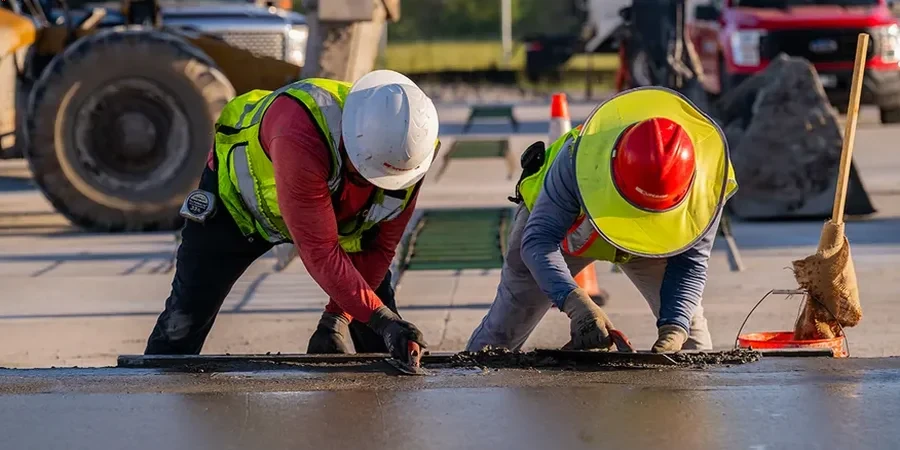
The stretch between North Sunnyvale’s tech campuses and the older grid south of El Camino Real tells two different soil stories. Near Moffett Field the clays run deep and hold moisture like a sponge; south of 280 the alluvial fans thin out over older basin deposits. Each condition demands a distinct approach to rigid pavement design, because a slab-on-grade that performs beautifully near Fair Oaks Park can curl and crack a mile east if the subgrade modulus shifts by 20%. We start every rigid pavement design with a site-specific subgrade investigation—attenberg limits, R-value, and k-value—so the slab thickness and joint layout match what’s actually beneath the grade. For projects where the clay fraction exceeds 40%, we often recommend a grain-size analysis to pinpoint the fines content driving volume change, which directly affects the required reinforcement and joint spacing.
A well-designed rigid pavement slab distributes load so effectively that the critical variable is never the concrete—it’s the uniformity of what’s underneath it.
Site-specific factors
Sunnyvale sits at roughly 120 feet above sea level on the Santa Clara Valley floor, and the 1989 Loma Prieta quake—magnitude 6.9 with an epicenter just 50 miles south—reminded every engineer in the South Bay that basin amplification is real. For rigid pavement design, the risk isn’t just shaking; it’s the post-seismic settlement that occurs when saturated Bay Clay consolidates under cyclic loading. A slab that was flat on Friday can develop a 0.75-inch step fault by Tuesday if the subgrade liquefies or settles differentially. We model both the static and seismic load cases, factoring in the site-specific peak ground acceleration from the USGS hazard maps and the potential for moisture-driven volume change during the dry season—when Sunnyvale’s average July rainfall drops to near zero and shrinkage cracks open the subgrade. Joint detailing, dowel alignment, and a properly graded base course become the difference between a pavement that survives a moderate event with cosmetic cracking and one that requires panel replacement.
Standards that apply
AASHTO 1993 Guide for Design of Pavement Structures (rigid pavement chapters), ASTM C78 / C78M Standard Test Method for Flexural Strength of Concrete, ASTM D1196 Standard Test Method for Nonrepetitive Static Plate Load Tests of Soils, IBC 2024 (governing building code, adopted by City of Sunnyvale), Caltrans Highway Design Manual, Chapter 620 (Rigid Pavement)
Questions and answers
How much does rigid pavement design cost for a Sunnyvale industrial project?
For a typical rigid pavement design package covering a 20,000 to 80,000-square-foot industrial pad in Sunnyvale—including subgrade investigation, k-value testing, thickness design, and joint layout—budget between US$1,920 and US$6,770. The final number depends on the number of borings or test pits required, the complexity of the loading (forklift axle loads, container stacking), and whether construction-phase FWD verification is included.
What’s the biggest design mistake you see in Sunnyvale rigid pavements?
Assuming a uniform subgrade. The Santa Clara Valley has alluvial deposits that change over short distances, and a k-value that works for the west side of a site can be completely wrong for the east side. We’ve seen slabs designed for 150 pci that sat on subgrades testing below 80 pci—the result is excessive curling, joint spalling, and mid-panel cracks within two years. A proper investigation with enough test locations is the cheapest insurance on the project.
Do you handle both plain jointed and continuously reinforced concrete pavement design?
Yes. For most Sunnyvale commercial and industrial applications we recommend plain jointed concrete pavement with doweled joints—it’s cost-effective and performs well when joint spacing is matched to slab thickness. For heavy-duty applications like intermodal yards or fire lanes with frequent turning movements, we design continuously reinforced concrete pavement to eliminate transverse joints entirely. The choice depends on loading, maintenance tolerance, and the owner’s long-term operational plan.
What subgrade preparation do you require before placing the concrete slab?
We specify a minimum 95% relative compaction (ASTM D1557) on the top 12 inches of subgrade, verified by nuclear density gauge or sand cone testing. Over expansive Bay Clay zones we often require moisture conditioning to near optimum and a 6-to-8-inch aggregate base course that acts as a capillary break. The base must be open-graded enough to drain, but stable enough to support the paver and concrete trucks without rutting. We confirm base compaction and surface tolerance with a straightedge before any concrete is placed.